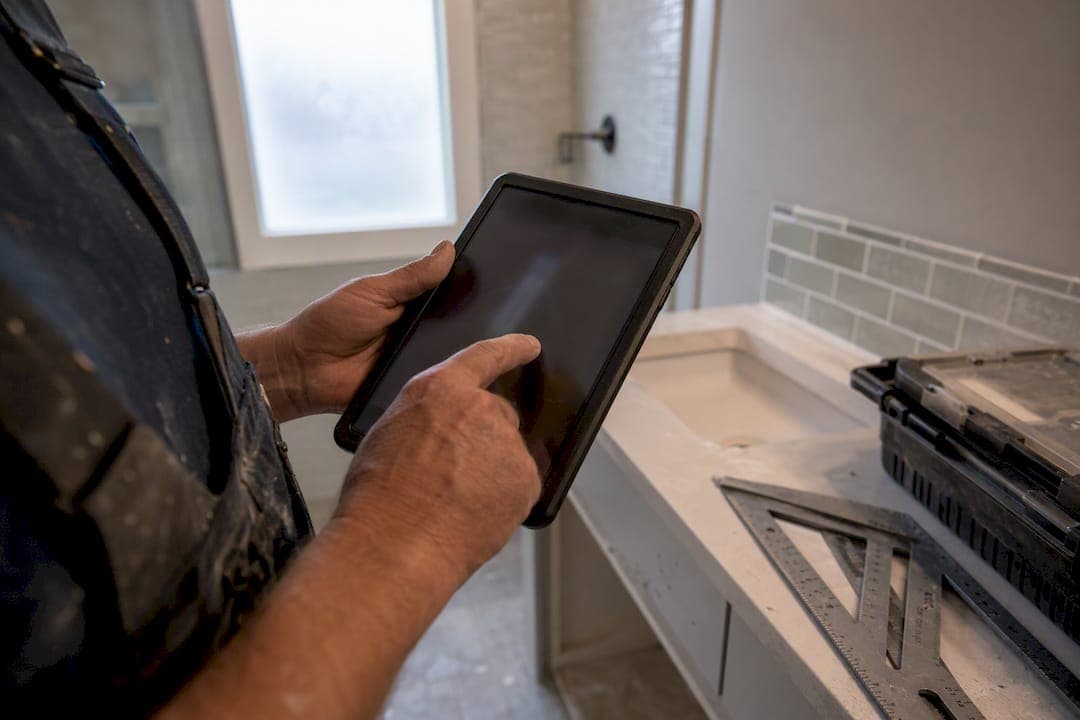
A construction punch list is the formal document that records every piece of unfinished or defective work standing between "almost done" and "done." It's the mechanism that forces accountability at the finish line, and it's directly tied to when you get your final check. Get it wrong, and retainage sits unreleased for weeks. Get it right, and closeout takes days.
TL;DR:
- Detailed documentation of work, including specific descriptions, responsible parties, and photographic evidence, reduces disputes and ensures clear accountability.
- Conducting internal pre-walks and structured walkthroughs minimizes the risk of unresolved punch list items delaying project completion.
- Properly categorizing and prioritizing punch list itemsaligns repairs with safety and occupancy needs, preventing unnecessary scope disputes.
- Using specialized punch list apps with photo attachment and notification features improves tracking efficiency for larger or multi-site projects.
- Owner-led oversight with thorough pre-walks and clear scope agreements prevents lengthy disagreements, enabling faster closeout and final payments.
Table of Contents
- What Is a Punch List and When Does It Happen?
- Who's Responsible for the Punch List, and When Should Walkthroughs Happen?
- What Should a Punch List Template Include?
- What Are Common Punch List Items by Trade?
- How Do You Run the Punch-List Process Without Dragging It Out?
- How Does the Punch List Affect Final Payment and Retainage?
- Should You Track Your Punch List on a Spreadsheet or an App?
- Why Owner-Led Oversight Changes How Punch Lists Actually Get Closed
- Get a Cleaner Closeout on Your Next Remodel
- Sources
What Is a Punch List and When Does It Happen?
A punch list, sometimes called a snag list or punch-out list, is a documented record of work that doesn't conform to the contract drawings or specifications. It might be a scuffed baseboard, a door that doesn't latch, or a light fixture wired backward. The name comes from the old habit of literally punching holes next to completed line items on a printed sheet.
You'll typically see the first formal punch list emerge when a project hits roughly 85 to 90 percent completion, right before the final inspection. That's the point where the big structural and mechanical work is done, and only finish details remain. The general contractor usually documents it, subcontractors execute the fixes on their own trades, and the owner or architect verifies the work before signing off. On smaller residential remodels, the owner and contractor often handle verification together, without a separate architect.
Who's Responsible for the Punch List, and When Should Walkthroughs Happen?
The general contractor owns the punch list. That doesn't mean the GC does the repairs personally. It means the GC is accountable for tracking every item to closure, even when six different subcontractors are responsible for the actual fixes.
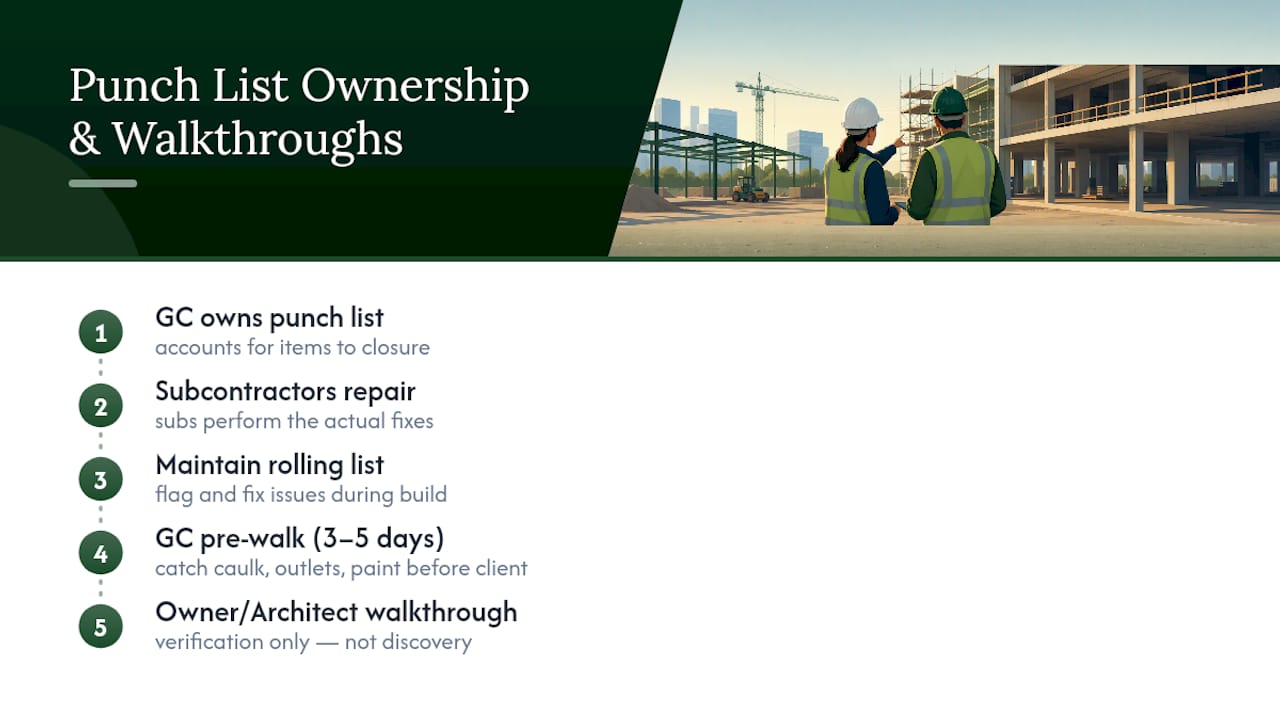
The smartest GCs run an internal pre-walk three to five days before the client ever sees the property. This catches sloppy caulk lines, missing outlet covers, and paint touch-ups before they become a client's first impression of "unfinished work." A rolling punch list maintained throughout the build cuts down what's left to find at this stage, since issues get flagged and fixed as they happen instead of piling up at the end.

Once the pre-walk items are cleared, the owner or architect does the formal walkthrough. Their job is verification, not discovery. If your pre-walk is thorough, this meeting should be short.
What Should a Punch List Template Include?
A usable punch list needs specific fields, not a vague notes column. Skip a field and you'll be chasing down "who was supposed to fix that" a week later.
Every line item should capture:
- Item number for tracking and reference
- Location (room, elevation, or unit number)
- Description of the defect, written specifically
- Assignee — the single person or trade responsible
- Priority level (High, Medium, Low)
- Due date
- Photo documenting the issue
- Status (open, in progress, complete, verified)
- Verifier who confirms the fix before it's marked closed
Vague items create disputes. "Fix bathroom" tells nobody anything. Write it the way a good template guides you to: "Guest bath, north wall: grout gap at tub surround, approximately 3/8 inch, needs re-grouting." That's specific enough that anyone on the crew can execute it without a follow-up phone call.
Priority matters too. High means it blocks occupancy or safety (a door that won't lock). Medium is cosmetic but visible daily (a paint scuff on a main wall). Low is minor and easily deferred (a nail pop in a closet).
| Item # | Location | Description | Priority | Due Date | Status |
|---|---|---|---|---|---|
| — | Primary bath | Grout gap, tub surround north wall | Medium | 3 days | Open |
| — | Kitchen | GFCI outlet not resetting near sink | High | few days | In progress |
| — | Hall closet | Nail pop, upper trim | Low | Before final walk | Open |
A complete template usually groups items into six sections: project header, interior, exterior, mechanical/electrical/plumbing (MEP), site cleanup, and sign-off. That structure keeps a 60-item list navigable instead of a scrolling mess.
What Are Common Punch List Items by Trade?
Certain issues show up on almost every project. Knowing the pattern speeds up your walkthrough because you know exactly where to look.
- Paint and drywall: touch-ups at seams, nail pops, inconsistent sheen or color batches
- Doors, windows, and trim: misaligned doors, missing or loose hardware, gaps in weatherstripping and seals
- MEP: unlabeled electrical panels, dripping faucets, weak HVAC airflow in far rooms, untested GFCI outlets
- Flooring and finishes: uneven transitions between rooms, scratches from installation, loose thresholds
- Exterior and site: poor grading near the foundation, misaligned gutters, leftover construction debris
Photo-documenting each of these during the walk isn't optional busywork. It's what settles disagreements about condition and cause when a sub claims "that was already like that."
How Do You Run the Punch-List Process Without Dragging It Out?
Closeout drags when nobody owns the sequence. A tight process runs in four stages:
- Internal pre-walk. The GC and site super walk the whole project alone and log everything, days before the client sees it.
- Client walkthrough. The owner or architect reviews what's left, ideally a short list because the pre-walk already caught most of it.
- Trade completion and verification. Each item goes to a single assigned trade with a due date, and someone other than that trade confirms the fix.
- Final sign-off. Once every item is verified, not just marked complete, the project closes formally.
Scheduling in waves by trade, rather than letting everyone show up at once, keeps the finish line from turning into a traffic jam. Electricians one day, painters the next, flooring crews after that. Daily check-ins on open items, even a five-minute stand-up, prevent a punch list from quietly stalling for a week.
The single biggest mistake is telling a client an item is done before someone verifies it. That erodes trust fast, and it's completely avoidable.
Pro Tip: Assign exactly one name to every punch list item, never a trade or a team. "Plumbing" doesn't show up to fix a leaky valve. A person does.
How Does the Punch List Affect Final Payment and Retainage?
Punch list completion isn't just a quality exercise. It's contractually load-bearing. Most contracts tie the Certificate of Substantial Completion and final payment directly to the punch list being closed out and verified.
Owners commonly withhold 5 to 10 percent of the total contract value as retainage specifically to guarantee punch list items get finished. That's real money sitting on the table until the last item is signed off.
If a fix is disputed, whether it's a defect at all or whose scope it falls under, document it in writing immediately with photos and a clear description, rather than letting it linger verbally. Genuine scope disagreements, additional work outside the original contract, belong in a formal change order, not a punch list line item. Mixing the two is how disputes drag into weeks instead of days.
Should You Track Your Punch List on a Spreadsheet or an App?
For a single kitchen remodel with two or three subs, a shared spreadsheet works fine. It's low friction and everyone already knows how to use it.
Once you're juggling multiple trades across a larger remodel or an ADU build, a mobile punch-list app pays for itself. Photos attach automatically, timestamps prevent "I already fixed that" arguments, and assignees get notified the second an item is logged. For multi-site operations or larger crews, an integrated project management platform that ties punch lists to scheduling and budgets, similar to the kind of lightweight automation covered by Cursor Cat Digital, tends to be worth the setup time.

Why Owner-Led Oversight Changes How Punch Lists Actually Get Closed
Most punch-list disputes trace back to one root cause: nobody agreed on what "done" meant in the first place. That's the gap conventional advice skips. You can have the cleanest template in the industry and still argue for two weeks over whether a tile pattern matches "what was promised."
At Hnconstructiontx, every project is led by an owner, not handed off between a sales rep, a designer, and a rotating site super who never saw the original plans. That continuity matters more at closeout than at any other phase, because the person walking the punch list with you is the same person who approved the scope on day one. Pairing that with 3D renderings before work starts removes most of the "that's not what I expected" arguments before they can even become punch list items. A rolling, photo-driven pre-walk is standard on every job, not an afterthought bolted on at the end.
— Atlas
Get a Cleaner Closeout on Your Next Remodel
Hnconstructiontx approaches every kitchen remodel, bathroom renovation, ADU build, and outdoor living project the way this article recommends handling a punch list: with a rolling checklist, photo documentation, and a single owner accountable from the first rendering to the final walkthrough. That's the direct alternative to hiring a contractor who hands your project between three different site managers before you ever see a completion certificate.
Browse finished results in the kitchen and bathroom remodel gallery or the outdoor living project gallery to see what a clean closeout actually looks like. If you're planning a remodel or an ADU in Austin or Dallas, request an estimate and get your project scoped with 3D renderings before a single hammer swings.
Sources
- PUNCH LIST | English meaning - Cambridge Dictionary
- Building the Perfect Construction Punch List
- Punch list — Wikipedia
- Construction Punch List Template: The Complete Closeout Checklist for Contractors in 2026