
A licensed and insured contractor holds an active license where your state or city requires one, carries general liability insurance (and workers' compensation if they have employees), and has any required bonds on file with the licensing board. If a contractor claims all three, don't take their word for it. Pull the license number, check it on the official state portal, and ask for a current Certificate of Insurance before signing anything.
TL;DR:
- Verify the contractor's license number on the official state portal and ensure it is current and matches the scope of work.
- Require a current Certificate of Insurance and confirm the contractor is listed as an additional insured for larger projects, then verify coverage directly with the insurer.
- Avoid unlicensed, uninsured, or unbonded contractors to prevent unenforceable contracts, liability for injuries, and liens from unpaid subcontractors.
- Check licensing requirements and bond/insurance standards specific to your state, as these vary widely across jurisdictions.
- A strong minimum standard includes active licensing, at least one million dollars in general liability insurance, workers' compensation if applicable, and a valid license bond.
Table of Contents
- Licensed vs. Bonded vs. Insured: What Each One Actually Covers
- How to Verify a Contractor's License, Bond, and Insurance
- What Happens When a Contractor Skips These Protections
- Licensing Rules Change by State, So Check Yours
- How HN Construction & Remodeling Handles Licensing and Insurance
- The Minimum Standard I Require Before Signing Anything
- Get Your License, Bond, and Insurance Details Verified
- Sources
Licensed vs. Bonded vs. Insured: What Each One Actually Covers
These three words get lumped together so often that most homeowners assume they're basically the same protection wearing different hats. They're not. Each one guards against a different failure, and understanding the difference is the whole reason to ask about all three separately.
Licensed means the contractor passed a trade or business exam, met experience requirements, and got approval from a state or local board to legally operate. Licensing scope varies enormously. Some states issue general contractor licenses that cover almost any residential work; others require separate licenses for electrical, plumbing, or HVAC trades regardless of who's running the job.
Bonded means a surety company has agreed to pay out if the contractor fails to meet contractual or legal obligations. A license bond, the most common type homeowners run into, isn't insurance for the contractor. It's a guarantee to the state (and indirectly to you) that if the contractor violates licensing law, money is available to cover the claim. Performance and payment bonds work similarly but focus on finishing the job and paying subcontractors.
Insured covers accidents and damage during the work itself. That breaks into three categories homeowners should know:
- General liability insurance pays for property damage or third-party injuries caused by the contractor's work.
- Workers' compensation covers medical costs and lost wages if a worker gets hurt on your property, protecting you from being sued directly.
- Professional liability insurance (less common on residential jobs) covers design or planning errors on more complex projects.
A surety bond guarantees contract performance and payment to subcontractors, while insurance covers injuries and property damage instead. They protect different people, and a contractor can have one without the other.
How to Verify a Contractor's License, Bond, and Insurance
Verification takes maybe fifteen minutes, and it's the fifteen minutes that separates homeowners who get burned from homeowners who don't.
- Get the exact license number and business name. Don't accept "I'm licensed" as an answer. Ask for the number printed on their card or contract.
- Confirm the bond is active and matches the license. The same portal often lists whether a license bond is currently on file. If it's lapsed, the license is typically invalid even if the number still shows up in a search.
- Request a Certificate of Insurance (COI), specifically ACORD 25 form. This is the standard industry document showing coverage type, limits, carrier, and policy dates.
- Ask to be named as an additional insured for larger projects. A COI only confirms a policy existed at the moment it was issued; it doesn't give you any coverage rights. An additional insured endorsement does.
- Call the insurance carrier directly. Confirm the policy is active, matches the limits on the COI, and hasn't been canceled since the certificate was printed.
- Ask about subcontractors' coverage. If the general contractor's crew includes subs, their insurance gaps become your exposure. Verify subs carry their own coverage or ask for a project-wide policy that covers everyone on site.
Pro Tip: Never accept a COI as the final word on a major remodel or ADU build. Call the carrier listed on the certificate, ask them to confirm the endorsement and its effective dates, and get that confirmation in writing before work starts.
What Happens When a Contractor Skips These Protections
The gaps here aren't theoretical. They show up in real disputes, and they usually surface at the worst possible time, mid-project, after money has already changed hands.
Hiring an unlicensed contractor can leave you with an unenforceable contract in states that require licensing for the work performed. That means limited legal standing if the job goes sideways, plus exposure to liens, code violations, and in some states, fines or forced work stoppages once a building inspector or the licensing board catches the violation.
No insurance shifts risk directly onto you. If an uninsured worker falls off your roof, you can be named in a lawsuit, and your homeowner's policy may deny the claim since it wasn't written to cover a contractor's job site.
No bond means little to no recourse if the contractor walks off mid-job or fails to pay subcontractors, who can then file a lien against your property even though you already paid the general contractor in full.
- Unlicensed work: unenforceable contracts, liens, fines, stop-work orders
- Uninsured work: personal liability for injuries and property damage, denied claims
- Unbonded work: no financial backstop for incomplete jobs or unpaid subs
If you discover a gap after work has started, stop the project, document everything with photos and written notes, and notify both the licensing board and your own insurer before any more money or work moves forward.
Licensing Rules Change by State, So Check Yours
Contractor licensing in the U.S. is not one national standard. It's a patchwork, and that patchwork is exactly why so many homeowners get tripped up.
Roughly 29 to 36 states require a state-level license for general contractors. The rest either delegate licensing to cities and counties or skip a formal license requirement altogether, relying instead on registration, bonding, or nothing at all beyond a business license. That means the exact same remodeling job can require a state exam and license in one state and just a local permit in the next.
Here's a quick way to sort out where you stand:
- If your state requires a license: verify it on the state board's portal, confirm the bond is current, and match the license classification to the actual scope of work.
- If licensing is handled locally: call your city or county building department, since many maintain their own contractor registries separate from any state list.
- If there's no license requirement at all: insurance and a detailed written contract become your main protection. Demand a COI, an additional insured endorsement, and clear payment terms before signing anything.
Bond amounts and insurance minimums also vary by state and license type, so don't assume the number a contractor quotes you is a fixed national standard. Bond and insurance requirements shift widely depending on the classification and jurisdiction. As a general reference point, surety bond premiums typically run 1% to 15% of the bond's face value annually, with contractors carrying strong credit often paying closer to 1% to 3%. If a contractor's bond premium sounds unusually high relative to that range, it can be a sign of past claims or credit trouble worth asking about directly.
For Texas homeowners specifically, there's no single statewide general contractor license, so verification runs through local permitting offices and direct confirmation with the contractor's insurer and bonding company.
How HN Construction & Remodeling Handles Licensing and Insurance
Every project at Hnconstructiontx is led by an owner, not handed off to a rotating cast of project managers, which keeps licensing, insurance, and bonding questions answered by someone who actually knows the job.
Before a single wall comes down, projects go through 3D renderings and detailed planning, which cuts down on the change orders and scope confusion that tend to expose homeowners to unbudgeted risk. Hnconstructiontx operates as a fully licensed and insured contractor across its Austin and Dallas service areas, backed by more than 400 completed kitchen, bathroom, ADU, and outdoor living projects.
When subcontractors are brought onto a job, a professional operation doesn't just take their word for coverage. It collects a current COI from each sub, confirms the policy dates and limits, and requests additional insured status on larger builds so gaps in a sub's coverage don't become the homeowner's liability. That's the standard homeowners should expect from anyone swinging a hammer on their property.
The Minimum Standard I Require Before Signing Anything
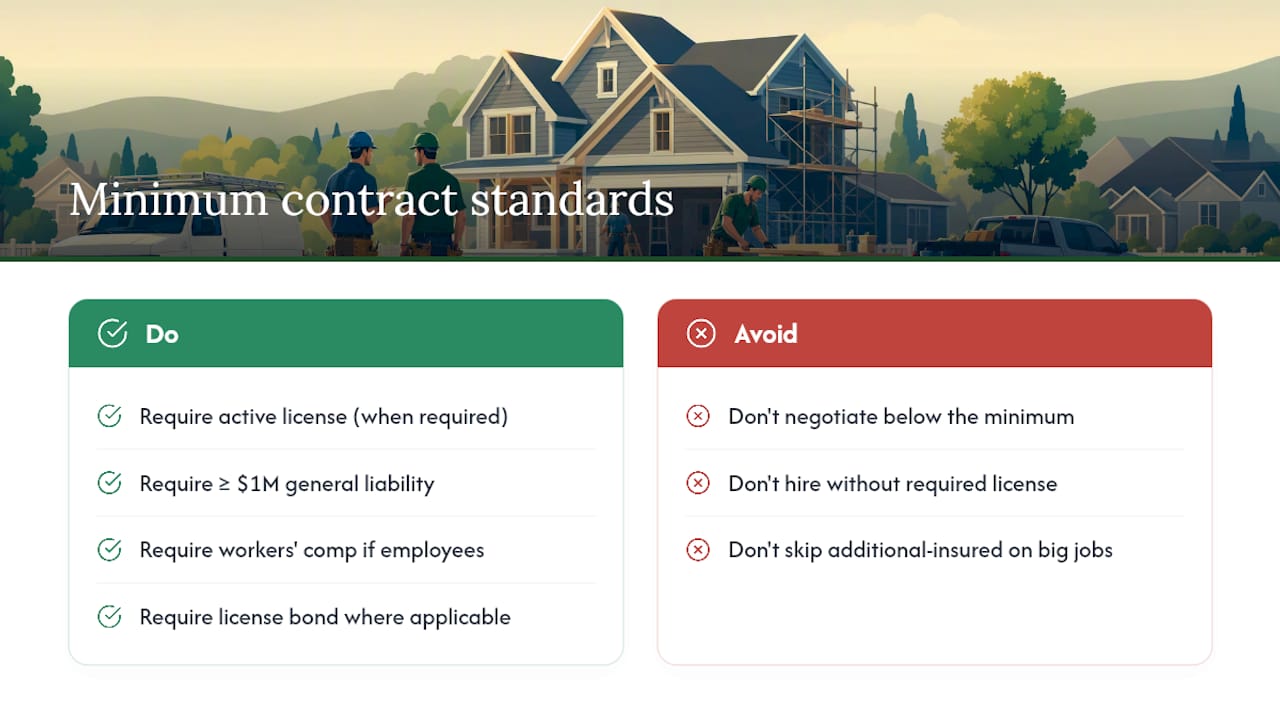
Here's where I land after digging through licensing boards, bond structures, and insurance fine print: don't negotiate on the floor, only on the ceiling. My minimum package is non-negotiable: an active license where the state or city requires one, general liability coverage of at least $1 million, workers' compensation if the contractor has employees, and a license bond on file where applicable.
For anything beyond a small repair, a licensed home builder or remodeler should also add you as an additional insured. That single endorsement is the difference between hoping a policy covers you and knowing it does.
— Atlas
Get Your License, Bond, and Insurance Details Verified
Hnconstructiontx gives Austin and Dallas homeowners something most contractor searches don't: an owner on the job from the first 3D rendering to the final walkthrough, backed by active licensing and insurance you can verify yourself instead of taking on faith.
If you're planning a kitchen or bathroom remodel, an ADU, or a new outdoor living space, ask directly for license numbers, current Certificates of Insurance, and bond documentation before signing a contract. Hnconstructiontx provides all three on request. Browse the kitchen and bathroom remodeling services or check out the ADU construction options for Austin and Dallas properties, then request a consultation to get your project scoped, priced, and verified from day one.
Sources
- Contractor bond vs. insurance: what's the difference? - LegalClarity
- How much does a surety bond cost? - NFP
- Additional insured vs. Certificate of Insurance - SIA Group