A line item estimate is a project cost breakdown that lists every task or material separately, each with its own quantity, unit price, and extended total, instead of one lump-sum number. Homeowners use it to compare contractor bids apples to apples, contractors use it to price and defend their scope, and insurers use it to price a claim. The moment you see one, check it against the plans and start hunting for what's missing.
TL;DR:
- Homeowners should verify that quantities match plans or site measurements and question vague or unspecified lines before accepting an estimate.
- Estimates should include detailed costs for each task, organized by trade, with real supplier or subcontractor prices, not guesses or rough averages.
- Overhead, profit, contingency, taxes, and permit fees are essential components that must be clearly itemized in every professional estimate.
- Quotes should be checked against actual subcontractor or supplier quotes, especially for bids that differ by more than 15–25 percent.
- A thorough, line-item estimate simplifies scope comparison, improves negotiation clarity, and reduces the risk of unexpected mid-project cost increases.
Table of Contents
- What is a line item estimate made of?
- Why does a detailed cost breakdown matter?
- How do you build a line item estimate?
- What does a sample line item estimate look like?
- How do you check if a contractor's estimate is fair?
- How does HN Construction prepare a line item estimate?
- What Homeowners Get Wrong About Estimates
- How Hnconstructiontx Turns Estimates Into Finished Projects
- Sources
What is a line item estimate made of?
Every line in a proper estimate has five parts: a description of the work, the unit of measure, the quantity, the unit cost, and the extended total (quantity times unit cost). Add up every extended total across the project and you get the estimate's bottom line. That structure is what separates a real estimate from a rough guess scrawled on a napkin.
Most detailed estimates group these lines into cost categories: materials, labor, equipment, subcontractors, and overhead and profit (often written as OH&P). Many professional templates organize those categories further using CSI MasterFormat divisions, a standardized numbering system that groups work by trade, such as Division 09 for finishes or Division 22 for plumbing. It's the same logic architects and engineers use on commercial jobs, scaled down for a kitchen remodel or a backyard deck.
Units of measure vary by trade:
- Square footage (SF) for flooring, drywall, and countertops
- Linear footage (LF) for trim, fencing, and baseboard
- Each (EA) for fixtures, appliances, and doors
- Cubic yards (CY) for concrete and excavation
- Lump sum (LS) reserved for work that genuinely can't be broken down further, like permit fees
Why does a detailed cost breakdown matter?
A line item estimate protects both sides of a contract. For a contractor, it's a paper trail: if a task isn't listed, the homeowner shouldn't expect it done, and that clarity heads off arguments before they start. For a homeowner, it's the only real way to compare two bids that look wildly different in total price but cover different scopes.
Insurance claims run on the same logic, just with higher stakes. Carriers price damage using line item software like Xactimate, and a homeowner's demand written the same way negotiates on equal footing instead of getting waved off as unsubstantiated. Line items also expose what a carrier quietly left out, whether that's drywall texture matching or hauling debris.
Situations where you should insist on one:
- Any remodel bid over a few thousand dollars
- Storm, water, or fire damage repairs going through insurance
- Additions or ADU builds with multiple trades involved
- Change-order negotiations mid-project
How do you build a line item estimate?
Professional estimators don't eyeball a number. They follow a repeatable sequence that turns plans into a defensible price.
- Start with plans and a measured takeoff. Walk the site or review drawings and count exact quantities: square feet of tile, linear feet of baseboard, number of outlets.
- Source real unit costs. Pull pricing from supplier quotes, subcontractor bids, or a cost database rather than guessing from memory.
- Calculate loaded labor costs. Labor isn't just an hourly wage; it includes payroll taxes, insurance, and burden rates that push the real cost well above what a worker takes home.
- Price equipment separately. Rented lifts, dumpsters, and specialty tools get their own line rather than getting buried in labor.
- Organize by division or trade and total the direct costs for each section before rolling them into the project total.
- Layer on general conditions, overhead, markup, contingency, and applicable tax. These aren't padding; they cover permits, supervision, insurance, and the unknowns every project runs into.
- Document assumptions, exclusions, and allowances. Note what's not included (say, appliance selection above a certain budget) so nobody argues about it later.
Pro Tip: Ask any bidder for their assumptions and exclusions in writing, not just their total price. The gap between two bids is usually hiding in what got left out, not what got padded.
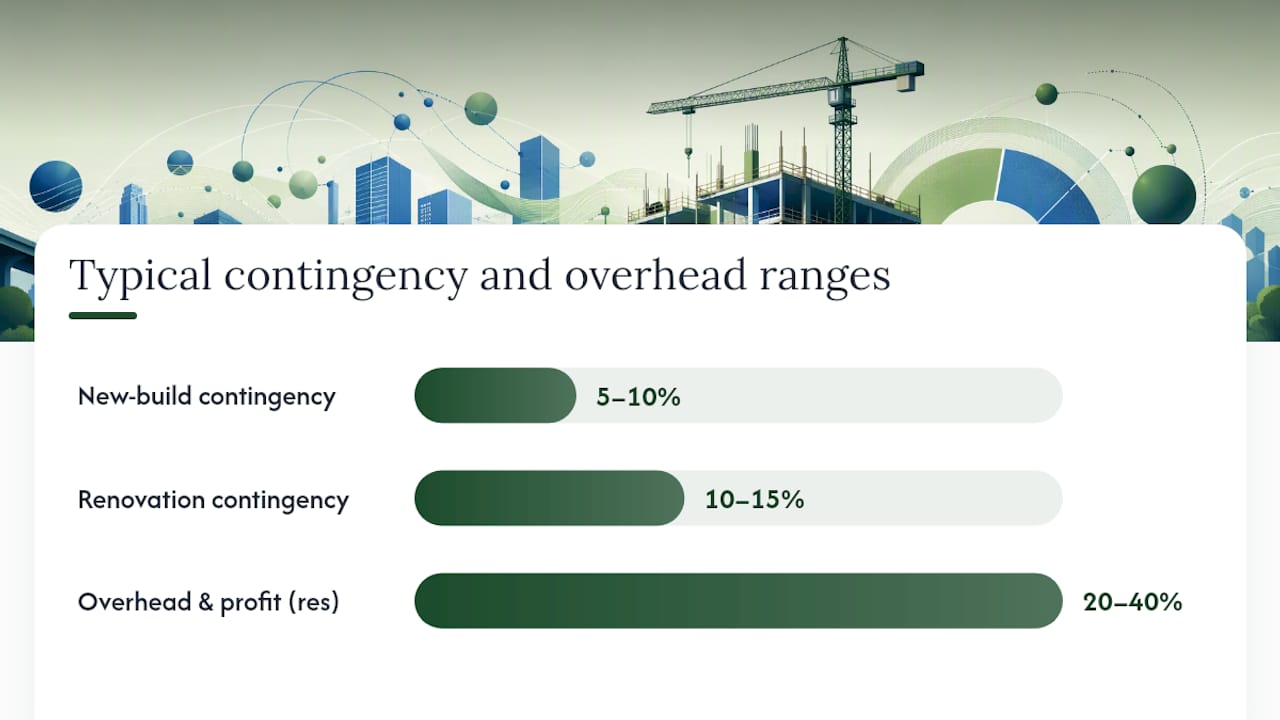
Contingency and overhead ranges vary by project type, and getting those wrong is one of the most common estimating mistakes. A well-defined new build with finished drawings might only need a 5–10% contingency, while a renovation full of unknowns behind existing walls should carry 10–15%, with overhead and profit commonly running 20–40% combined on residential work.
What does a sample line item estimate look like?
Here's how a handful of real lines might read on a bathroom remodel:
A usable spreadsheet or software template needs these columns at minimum: description, unit, quantity, unit cost, extended cost, supplier or sub name, and a notes field for anything unusual. That last column matters more than people think. It's where you write "tile allowance $4/SF, upgrade billed separately" so nobody's surprised at closeout.
How do you check if a contractor's estimate is fair?
Before you sign anything, run the estimate through a short checklist. This is the single most valuable ten minutes you'll spend on any remodel or claim.
- Do the quantities match your plans or an actual site measurement, not a rounded guess?
- Are prep and support trades listed, like demo, drying time, or paint matching, or did they vanish into "included"?
- Do unit prices line up with local supplier quotes or published price lists?
- Do overhead and profit, contingency, tax, permit fees, and disposal costs actually appear somewhere?
- Is there a vague "miscellaneous" or "supplies" line with no quantity or unit price attached?
Watch closely for unit-price gaps between comparable bids. Automated online estimating tools are convenient for a ballpark, but they commonly land ±15–25% off on fine-grained pricing, which is exactly why every serious estimate should get checked against real subcontractor or supplier quotes before you commit.
How does HN Construction prepare a line item estimate?
Hnconstructiontx builds every project estimate on a locked scope, not a guess. Before pricing anything, the team runs a measured takeoff and produces 3D renderings so the homeowner sees the finished kitchen, bathroom, or outdoor living space before a single wall comes down. That step alone eliminates most of the vague lump-sum lines that cause disputes later.
With over 14 years in business and 400-plus completed projects across Austin and Dallas, Hnconstructiontx operates as a fully licensed and insured contractor, with every job led by an owner rather than handed off to a rotating project manager. What that means for the estimate itself:
- Every task tied to a quantity and unit price, organized by trade
- Allowances and exclusions spelled out before contract signing
- 3D renderings attached so scope and price match what's actually being built
Use that same document in negotiation: if a line item feels vague, ask for the quantity behind it before you sign.
What Homeowners Get Wrong About Estimates
Most people treat an estimate as a single number to negotiate down. That's backwards. The number is the least useful part of the document; the line items behind it are where the actual decisions live. A $28,000 bathroom remodel and a $34,000 one aren't really $6,000 apart, they're different in scope, and you can't see that difference until you compare line by line.
The bigger blind spot is assuming a low bid and a thorough bid are competing on the same playing field. Often they're not. A contractor who lists demo, drying time, and disposal separately looks more expensive on paper than one who buries those costs in a "labor" lump sum, right up until change orders start appearing mid-project. Industry professionals treat the estimate as a project roadmap for exactly this reason: if it isn't listed, it isn't expected.
My take: stop asking "what's your price" first. Ask "walk me through your line items" first. The price question answers itself once you understand the scope behind it.
— Atlas
How Hnconstructiontx Turns Estimates Into Finished Projects
Reading a good estimate is one thing. Getting a contractor who actually builds to it is another. Hnconstructiontx is the option for Austin and Dallas homeowners who want a detailed, line-item-priced project without chasing down five subcontractors to fill the gaps a vague bid leaves behind.
Every project starts with a measured takeoff and 3D renderings, so the estimate you sign reflects the kitchen, bathroom, ADU, or outdoor living space you'll actually get, permits and utility hookups included where they apply. That upfront precision is the difference between a remodel that hits its number and one that racks up change orders three weeks in.
Hiring a licensed contractor makes sense the moment a project touches plumbing, electrical, structural work, or anything requiring a permit; a DIY estimate works fine for cosmetic updates, not for load-bearing walls or ADU construction. To get started, send your plans, photos of the existing space, and a rough scope of what you want changed. Request a detailed estimate and Hnconstructiontx will build out the line items and renderings before any work begins.
Sources
- Construction Cost Estimating: A Step-By-Step Guide | Procore
- Free Construction Estimate Template (2026) | Free Tool - EstimationPro AI
- Line-Item Estimate: Florida Insurance Glossary | Ocean Point Claims